Posts Tagged ‘cameras’


Choose an Article:

Surveillance Camera CCTV

Tuesday, September 27th, 2011

Today’s surveillance camera CCTV systems have made “leaps and bounds” in technological improvements compared to the systems from just 10 to 15 years ago.  Not only that, but the camera’s prices have steadily decreased with the increase in technology.  All of this has lead to video surveillance cameras becoming a “household word” for family protection and safety as well as business protection and workplace documentation.

Original surveillance camera CCTVs were based on analog signals.  These systems and components of the systems were often referred to as CCTV or Closed Circuit TeleVision.  CCTV was so named because although it closely resembled a typical television studio system, there was one major important difference.

Studio television cameras’ video signals were boosted by the broadcast station and sent via radio frequency via a large antenna.  Once the signal left the broadcast antenna, anyone with a receiver could pick up the signal.  Video surveillance cameras however, sent their signal along a cable, directly to a specific monitor and recording device.  In this respect, the system was a “Closed Circuit TeleVision” system.  In fact, any system used for monitoring, surveillance, or security in this manner was referred to as a CCTV system.

Today, video surveillance cameras still operate on a CCTV based system, but to be accurate, we must redefine CCTV to make it somewhat looser in application.  Although modern digital video surveillance cameras also transmit their video signals via a cable to a Digital Video Recorder or DVR and one or more monitors, they also employ additional methods for transmitting their signals that must be taken into consideration of the definition of CCTV as well.

These cameras may also transmit their video data wirelessly via an on-board camera transmitter and antenna.  These cameras use modern day wireless technology often used in land-line based telephones such as 2.4 or 5.8 GHz technology or 900Mhz technology for broadcasting their signal.  These systems are designed to transmit their signal to a nearby receiver, which is usually plugged in by cable, to a DVR and/or monitor.

Another method that is employed today is the use of the Internet as a vehicle for networking and transmitting.  Video surveillance camera CCTV and their DVRs have the capability for connecting to the Internet.  When they do possess this feature they are often referred to as Internet Protocol or IP ready, because they deliver their transmission using IP format technology.

Although it is true that individuals other than who the video images are intended for can gain access surreptitiously, the intent of these wireless broadcasts and Internet transmissions are directed to a limited number of very specific viewers.  Thus, although our definition for CCTV as now become a bit broader in scope, it is easy to see why even today, these units are often called surveillance camera CCTV systems.

While we are on the subject of CCTV versus new video surveillance cameras, it would be prudent to mention that there is some carry over from the “analog days” of CCTV to the current “digital era” which can make the comparison of components or the selection of a system somewhat confusing.  This primarily involves the use of reference to the detail or resolution of the video image created by the camera and displayed by the monitor.

Electronic video images may show a varying degree of detail.  That is evidenced by the contrast between standard television broadcasts and those called High Definition (HD).  Television was originally displayed on a Cathode Ray Tube or CRT (also called the “picture tube”).  The CRT reproduced the image on its screen by shooting an electron beam horizontally at the rate of about 60 times per second.  To a large degree, the number of horizontal lines determined how detailed the video appeared.  In this situation, the more lines, the smaller the lines, the greater the detail of the picture.

Today, however, most televisions are like computer monitors; they are Liquid Crystal Displays (LCD), plasma, or Light Emitting Diode (LED) displays.  These monitors display tiny dots called pixels instead of horizontal lines; therefore, they can display a much higher detail picture.  Yet, many video surveillance cameras still specify their picture quality in terms of the older, horizontal line method.  It’s important to know that the lower end of resolution or detail is from about 300 up to 650 TVL (TeleVision Lines).  Video surveillance cameras CCTV with 650 TVL displays can produce very high definition video images.

CCTV Video Server

Wednesday, July 13th, 2011

There are many ways to use the Internet these days to enhance your digital video security system and one such method may be to use a CCTV video server.  While the Digital Video Recorder or DVR is the center of the powerhouse for a digital video security and surveillance system, the CCTV video server could be considered its cousin, the major difference between the two being the CCTV video server is designed to work specifically with the Internet.

A typical digital video security and surveillance system works in the following manner:

  1. The digital cameras capture the video image and send it via a video transmission cable (for distinction here the cable is usually RG59) to the DVR (or a spot monitor)
  2. The DVR processes the video data; it compresses it using a CODEC (COmpression/DECompression) utility that reduces the size of the file but maintains high levels of quality in the video image.
  3. The DVR records the video to its Hard Disk Drive or HDD and also displays the image on a monitor.

In the above example, the system is usually self-contained in a specific geographical area because the cameras must be cabled to the DVR.  There are wireless cameras and other equipment but for the most part, these systems are still located in one specific location.

CCTV video servers are used as an adjunct to the older analog systems.  A typical analog video security and surveillance system with a CCTV video server works in the following manner:

  1. The analog (or digital) cameras capture the video image and send it via a video transmission cable (RG59) to the CCTV video server.  Note that a video server normally works with analog systems but may work with digital systems as well.
  2. The CCTV video server processes the video data; it compresses it using a CODEC.  Often, the CCTV video server will use more than one CODEC.  For example the server may save the cameras’ video images to the HDD using MJPEG technology, but for video that may be watched over the Internet, H.264 may be used to “stream” the video to its destination.
  3. The CCTV normally doesn’t use a monitor except for setup.  Usually its video feeds are processed (using H.264 for example) and are sent out over the Internet where they may be downloaded and viewed on any compatible computer.

As you can see, the biggest difference between a DVR and a video server is that the images remain local to the DVR while CCTV video servers digitize the analog signal and make it accessible via efficient streaming over the Internet.  There are advantages and disadvantages to the CCTV video server experience.  We’ll a mention a few of each in the following paragraphs.

(As a side note, Security Camera King has all but eliminated the need for a CCTV video server with its newest DVRs as each one contains its own Web server technology.  By going through the DVR oe can access every camera in the system over the internet.)

Probably the one single greatest benefit of all of a CCTV video server is the ability to view analog video over the Internet.  For analog systems, specifically cameras, this is not possible without a video server.

Another huge benefit of the CCTV video server is that the unit is able to save the video image to its HDD or send it along to a DVR to record to its HDD, and broadcast it in a streaming fashion over the Internet simultaneously.  This may not sound very impressive since Security Camera King’s feature digital systems can easily do all of this and more. But it is a convenient way of utilizing older analog cameras using the Internet.

The down side to using a CCTV video server and analog cameras is that if the Internet goes down, you will not be able to access your system remotely.  Also, a slow connection will yield a painstakingly slow monitoring experience.

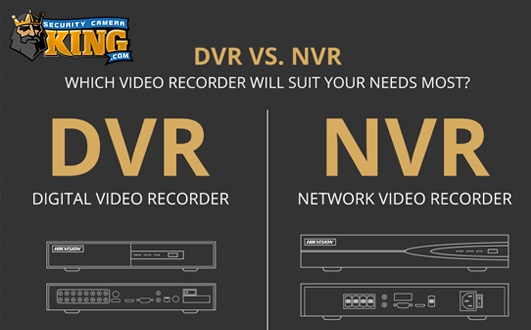
One last thing; don’t confuse CCTV video servers with Network Video Recorders (NVRs).  NVRs do not work with analog cameras; they are designed for use with IP (Internet Protocol) ready cameras.  NVRs are basically the IP ready camera’s equivalent of the DVR while CCTV video servers simply get the camera’s video IP ready and broadcasts it over the internet.

PTZ Web Camera

Thursday, June 23rd, 2011

There are very few things in the digital video security and surveillance system industry that are more versatile than a Pan-Tilt-Zoom or PTZ Web camera. These cameras merge the technological wonders of digital cameras with the speed and omnipresence of the Internet to yield an inexpensive, versatile monitoring tool.

There are basically two types of PTZ, one where a small motor moves the camera horizontally or vertically and zooms remotely or electronic PTZ which is truly electronic – no motors, it just a digital PTZ. Our main concern for this article is the first example mentioned; cameras designed with built-in motors to move the lens horizontally and vertically and also another small motor to move the lens for small or wide shots.

The alternative to this is digital PTZ. Using this method the camera is aimed at the general area that needs to be monitored and the digital controls make changes within the field of view that allow you to Pan-Tilt-Zoom. Some cameras may contain both digital PTZ and the motorized type of PTZ.

A PTZ Web camera has two great features that make it an incredibly versatile piece of equipment. Sometimes two PTZ Web cameras is all you need to do the job of 4 or more stationary cameras. A good example is a customer who bought two PTZ Web cameras from us to use for construction surveillance. Before they begin construction the first thing they do is set the poles for the two cameras. Based on his comments, they haven’t needed more than the two PTZ Web Cameras yet.

A PTZ Web camera can Pan (move horizontally usually in at least 180 degrees if not a full 360), Tilt (move vertically usually through 180 degrees of movement), and Zoom (enlarge the shot so as to magnify distant objects so they are bigger and show detail).

These cameras are great for perimeter use, parking lots and parking garages, store or other commercial business parking areas, and just about anywhere you need to place a camera that needs to cover more area that just its own initial field of view.

In addition to PTZ many of these cameras come with built in “track and follow” technology. That means that a PTZ Web camera can actually detect motion from a vehicle or a person entering its field of view and the track or follow and zoom in on that object to obtain the best view. The camera will follow the object as long as it is in the PTZ total field of view.

The second feature of a PTZ Web camera that makes it so versatile is the fact that it is an IP (Internet Protocol) ready camera that can be easily connected to broadband Internet service and accesses just about anywhere in the world there is Internet access including 3G and 4G cell phones. With this technology, you could be in Japan and your home and security system could be in Florida and from Japan you could monitor your camera and manually use the PTZ functions all from a smartphone.

PTZ Web cameras can also be collectively networked which means that if you have PTZ Web cameras that are IP ready and are located in different locations (distance between the two cameras doesn’t really matter as they are being networked through the Internet) you can treat them as though they are all part of one system. Instead of using a Digital Video Recorder (DVR) you use a Network Video Recorder (NVR) to record, access, monitor and control your cameras.

It is important to note here that Security Camera King features 4 different DVRs, the Elite-Mini Economy, the Elite-Mini HD, the Elite series, and the Ultimate series. All of these DVRs have Web server and Internet technology built right into the unit so you can do the same type of networking with these cameras that you could with a more expensive PTZ Web camera.

However, cameras could not be placed in different locations that are miles away. In this type of system all the cameras on your DVR (such as a home system) would be accessible. But you could access these cameras just like the PTZ Web camera without the added cost of an NVR and without the need for a Web ready camera.

As you can see the power and versatility of a PTZ Web camera is nearly unimaginable. Coupled with the use of the Internet for networking there is almost no limit to this system’s capabilities.

Home Video Surveillance

Monday, March 14th, 2011

In this day and age home video surveillance is becoming more of a necessity than an accessory.  Digital video security and surveillance systems are very affordable and meet just about any budget.  In addition, the systems are easy to install and do not require installation by a professional.

Not too long ago, home video surveillance was a luxury that only the incredibly wealthy could afford.  That’s because the cameras and recording machinery were expensive; it normally required a licensed contractor or professional to install the system, and remote monitoring-if it could be done at all, was also expensive.

These were the times when cameras worked on the basis of the analog format only and video recorders were usually tape formats of either Beta or VHS formats.  If one could afford remote monitoring, it was normally done by sending the system’s signal via radio frequency to a nearby monitoring station, which also was expensive.

However, in the late 1990′s to the turn of the century, the digital age had spawned the Digital Video Recorder or DVR.  The DVR was used for many applications including recording television shows from cable or satellite subscribers.  There were many advantages to digital recording as compared to its analog tape counterpart.  One major difference is that the digital recording does not degrade over time like a VHS or Beta Tape.  In addition, instead of using “looping” recording tapes, DVR’s could just start recording over on their hard disk drives.

As we “fast-forward” our account of the video security industry there have been several additional changes that have made home video surveillance more of a commonplace item than a rarity.  Technological advances in electronics as well as computers have yielded powerful, smaller, and more efficient security components such as cameras, microphones, and monitors.

Today’s digital video security and surveillance system is more apt to be a component system.  That is, individual pieces work and coordinate together to produce the outcome of the total system, much like the different peripheral devices of a computer.  This has definitely proven itself advantageous for home video surveillance.  Now homeowners can design systems with specific requirements and meet those needs using different components.  In essence, the age of the “tailor made” or “individualized” home video surveillance system is here.

A typical home video surveillance system consists of three separate components; the cameras, the DVR and the monitors.  Modern digital video surveillance systems don’t even necessarily require a monitor except to set the system up.  However, the monitor is still probably the most widely used component of the system but may become not nearly as important in the future.

This is because more digital systems are becoming Internet compatible.  For example, each of the feature DVRs offered by Security Camera King have built in Web server technology.  That means that once connected to the Internet one or more users can control and view the home video surveillance system remotely, either from another Internet connected computer or a smart phone.  Therefore, the use of a local system monitor is slowly becoming limited.

For that matter, with an increase in technology, newer features and improvements are being regularly added at astoundingly economical costs.  Home video surveillance requires cameras of course, to gather the image (in the digital world this is referred to as “capturing).  The digital video camera features available today seem almost limitless.  Here’s a short list of just some of the features offered for digital video cameras:

  • Infrared based total darkness video capture;
  • Motion Detection;
  • Pan-Tilt-Zoom or PTZ camera movements;
  • Wireless equipment; and,
  • Internet Protocol or IP ready cameras that connect directly to the Internet.

There are as many features available for DVRs as there are uses.  The following is a very short list of the many features offered for DVRs:

  • IP ready DVRs;
  • Motion Detection at the DVR level;
  • Pentaplex operation ( the ability to simultaneously monitor, record, playback, network, and backup);
  • Email notification alerts;
  • Burglar alarm sensor inputs and alarm devices outputs;
  • High resolution recording with high definition playback;
  • Two way voice support; and
  • The ability to add additional internal hard disk drives, CD/DVD writers, external Thumb drives, SD cards and other peripherals.

These are just a few of the features that are offered by today’s home video surveillance systems.  If you are interested in purchasing a system or would like to inquire about one or any of its features, contact Security Camera King today.

Security Camera Monitor

Thursday, March 3rd, 2011

The security camera monitor is probably considered one of the most important components of a digital video security system.  Yet, it is not purchased as often as other components like cameras and Digital Video Recorders (DVRs) and today’s systems can actually run without one.  In fact, Security Camera King takes pride in offering a complete digital video security package that includes the cameras, cables, connectors, power supply, and DVR but no monitor.  Why is that?  Read on to find out why, and to learn some other interesting facts about the security camera monitor.

There are three types of security camera monitors based on how they are used.  The first is a set-up monitor.  This monitor is only used when the system is first installed or any future changes are made to the system.  It may come in a variety of styles and sizes.  Security Camera King offers, for example, our product number VX-WLCDM, a 2.5 inch LCD service monitor with a wrist strap.

Use this monitor to aim cameras, choose settings on the DVR, and check connections.  Once the system is set up or the changes are made, the monitor is usually disconnected from the system.

The second type of security camera monitor is called the “spot monitor.”  A spot monitor is usually a monitor that is connected to just one camera.  It allows the user to specifically monitor full-time that one area of the security system that the specific camera covers.  The monitor maybe located in close vicinity of the camera it is monitoring or may be located in another location, whichever is most appropriate for the user.

If the spot monitor is used on a “cabled” system, there must be a separate cable run to the spot monitor in addition to the DVR.  This is usually accomplished by adding a splitter to the cable at some point to create a feed to the spot monitor and another to the DVR input.

The third type of security camera monitor is the system or main monitor.  This monitor is generally connected to the DVR by one or more cables and displays the on-screen information of the cameras and the DVR.  Usually this monitor is bigger in size than a spot monitor so that it can accommodate the simultaneous displaying of all or groups of cameras in the system at the same time.

Security camera monitors are like televisions (or perhaps more like personal computer monitors) in composition.  There are basically two types of monitors that are used today, but generally there is only one type that is used the most often.  The two types based on composition are the CRT and LCD monitors.

The CRT or Cathode Ray Tube monitor is the oldest type.  As its name implies it consists of a Cathode Ray Tube that produces the picture.  The CRT monitor is bulkier, heavier, and produces a lower resolution picture than the LCD monitor; basically, its equivalent to the older models of televisions that also used a CRT.  These monitors are still used today, but usually in older systems or as spot monitors.

The LCD or Liquid Crystal Display security camera monitor is probably the single most popular monitor type in use today.  It is much lighter than the CRT, it uses less energy, and displays at a much higher resolution and color, capable of providing quality high definition displays.  These monitors were once limited in size, but as technology advances so do the available sizes.  Security Camera King offers monitors as large as 42 inches.

A monitor is required to initially set-up a system.  However, all systems do not necessarily have system monitors.  The reason for is because once the system is set up it can record and function automatically.  More often however, users have personal computer systems or older monitors from computer systems in which the system is outdated but the monitor is still useful.  Then again, many users opt to connect their systems to the Internet and use any computer system’s monitor or even a Smartphone instead.

One last note; if you are considering purchasing a security camera monitor, regardless of the type, make sure the monitor has the proper connection input type available.  Our DVRs have HDMI, VGA, and BNC connections to make connecting the monitor an easy process for you.  However, many monitors, especially those once used for computers, only have a VGA connection for example.  So be certain to make sure your monitors, camera and DVR display types, and connectors match.